


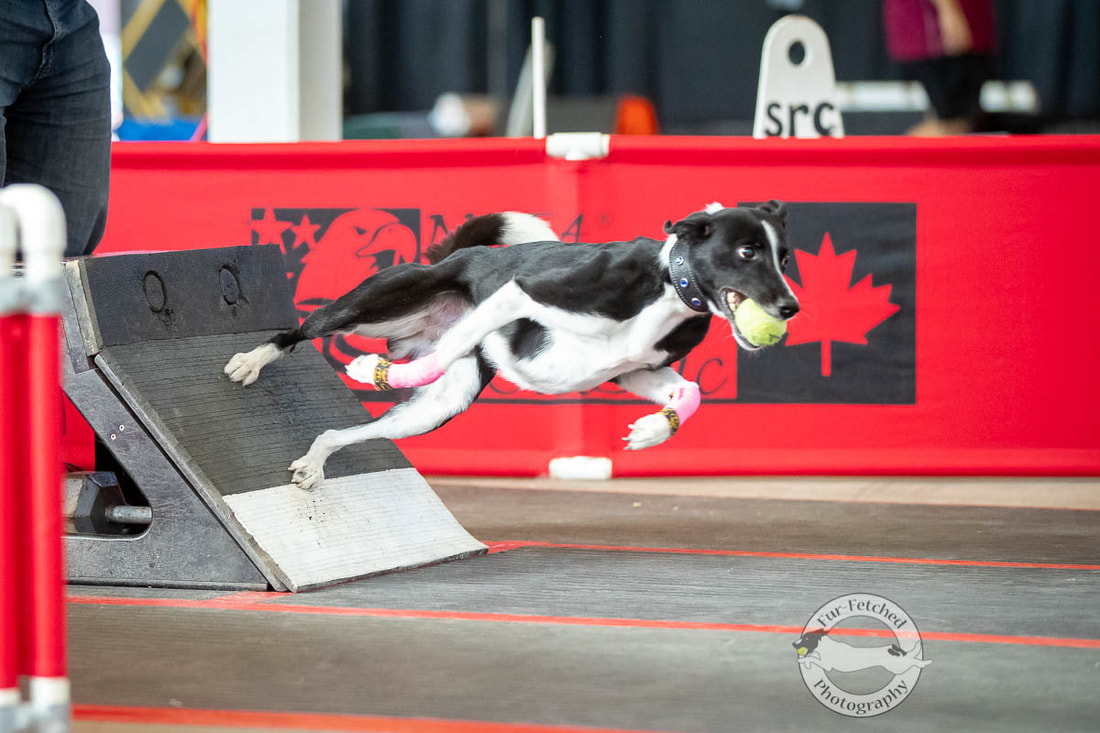
If you’ve ever thought your dog had a bit too much energy, or if “ball is life” is the unofficial motto of your household, then you’ve likely stumbled upon the perfect outlet: Flyball.
While agility is often compared to a graceful equestrian jumping event, Flyball is the canine equivalent of a drag race mixed with a relay swim meet. It is loud, it is fast, and it is arguably the most addictive team sport in the dog world. In this 1,500-word guide, we’re going to break down everything from the mechanics of the “box turn” to the electric atmosphere of a world-class tournament.
What is Flyball? The Basics of the Race
Flyball is a relay race involving two teams of four dogs. The setup is straightforward but requires precision timing. Two lanes are set up side-by-side, each featuring a sequence of four hurdles leading to a spring-loaded box.
The sequence of a Flyball run looks like this:
- On the signal, the first dog is released.
- The dog jumps over four hurdles spaced 10 feet apart.
- The dog reaches the Flyball box, hits a padded trigger with its paws, and catches a tennis ball that is launched into the air.
- The dog performs a “swimmer’s turn” off the box and carries the ball back over the four hurdles.
- As the first dog crosses the start/finish line, the next dog is released.
The race continues until all four dogs have completed the course without errors. The first team to have all four dogs cross the finish line with their balls wins the heat.
The Mechanics of a Champion: The “Swimmer’s Turn”
To the untrained eye, it looks like a dog simply running to a box and heading back. However, at the competitive level, the Flyball turn is a work of aerodynamic art.
If a dog stops at the box, catches the ball, and then turns around, they lose valuable seconds. Instead, top-tier Flyball dogs are trained to perform a “swimmer’s turn” or a “box turn.” Similar to how a competitive swimmer flips off the wall of a pool to gain momentum, a Flyball dog uses the box as a launchpad.
The dog hits the box with all four feet, catches the ball mid-turn, and uses the spring of the box to propel themselves back toward the hurdles. A perfect turn can shave a full second off a run—and in a sport where races are won by 0.001 seconds, that’s an eternity.
The Art of the “Pass”
In Flyball, the most nerve-wracking moment for a handler is the pass. This is when one dog is returning with the ball and the next dog is charging toward the first hurdle.
Ideally, the dogs should pass “nose-to-nose” right at the start/finish line. If the second dog crosses the line before the first dog has returned, it’s a “pre-start” (a foul), and that dog must run again at the end of the heat. If the gap between the dogs is too wide, the team loses time.
Watching two dogs—often different breeds and sizes—rocket past each other at full speed with only inches of clearance is one of the most exhilarating sights in any animal sport.
Is Your Dog a Flyball Candidate?
One of the greatest things about Flyball is its inclusivity. Unlike some sports that are dominated by specific breeds, Flyball welcomes everyone. From Chihuahuas to Great Danes, if a dog can jump and has “ball drive,” they can play.
1. The “Height Dog” Advantage
You might think that a team of four Border Collies is the ultimate lineup. However, Flyball has a clever rule regarding hurdle height. The height of the hurdles is determined by the “height dog”—the smallest dog on the team.
- If a team has a tiny Jack Russell Terrier, the hurdles are lowered for everyone on the team.
- This makes the “Height Dog” the most valuable player on many squads, as they allow the larger, faster dogs to clear the hurdles with less effort.
2. Temperament and Socialization
Flyball is loud. Between the barking dogs, the shouting handlers, and the thud of the boxes, it’s a sensory-heavy environment. A good Flyball dog needs to be “rock solid” under pressure. They must be able to ignore the dog in the lane next to them (who is often only a few feet away) and focus entirely on their handler and the box.
3. Physical Fitness
Because Flyball involves high-speed sprinting and sharp turns, dogs must be in peak physical condition. It is a high-impact sport. Owners must focus on:
- Core strength to protect the spine during turns.
- Toe and nail health for gripping the floor.
- Warm-ups and cool-downs to prevent muscle tears.
The Benefits: Why We Do It
Why do people travel hundreds of miles to stand in a noisy warehouse and watch dogs chase tennis balls?
- Unrivaled Bond: Training a dog to ignore every instinct and perform a complex relay requires a deep level of trust. The “Flyball High” you feel when your dog nails a perfect pass is incomparable.
- The Community: Flyball is a team sport for humans, too. You aren’t just a handler; you’re part of a crew. You cheer for your teammates, help load the boxes, and celebrate the wins together.
- Mental Exhaustion: For high-drive dogs (the ones who chew your baseboards if they don’t get a job), Flyball is a miracle. The mental focus required to navigate the hurdles and the box while ignoring distractions leaves them blissfully tired for days.
Starting Your Journey: From Backyard to Big Leagues
If you think your dog is the next Flyball star, here is how you get started:
- Find a Local Club: Flyball is not a solo sport. You need a team and a specialized box. Most clubs offer “Intro to Flyball” clinics where they test your dog’s interest in the ball and their ability to recall under distraction.
- Focus on the Recall: Before your dog ever sees a hurdle, they need a “bulletproof” recall. They must want to come back to you more than they want to keep the ball or play with other dogs.
- The Box Training: This is usually done in stages using “ramps” to teach the dog the correct footwork before the actual spring-loaded box is introduced.
- Join an Association: Most teams compete under the North American Flyball Association (NAFA) or the United Flyball League International (UFLI). These organizations keep track of points, titles, and regional rankings.
Conclusion: More Than Just a Game
Flyball is a celebration of the “working” heart that beats inside our pet dogs. It turns a simple game of fetch into a masterpiece of timing, speed, and cooperation. It’s a sport where the underdog can be the MVP, and where a split second is the difference between a “Personal Best” and just another Saturday.
If you have a dog that lives for the chase, look up a local Flyball club. Just be warned: once you hear the “ready, set, go” and the roar of the crowd, there’s no turning back.

