


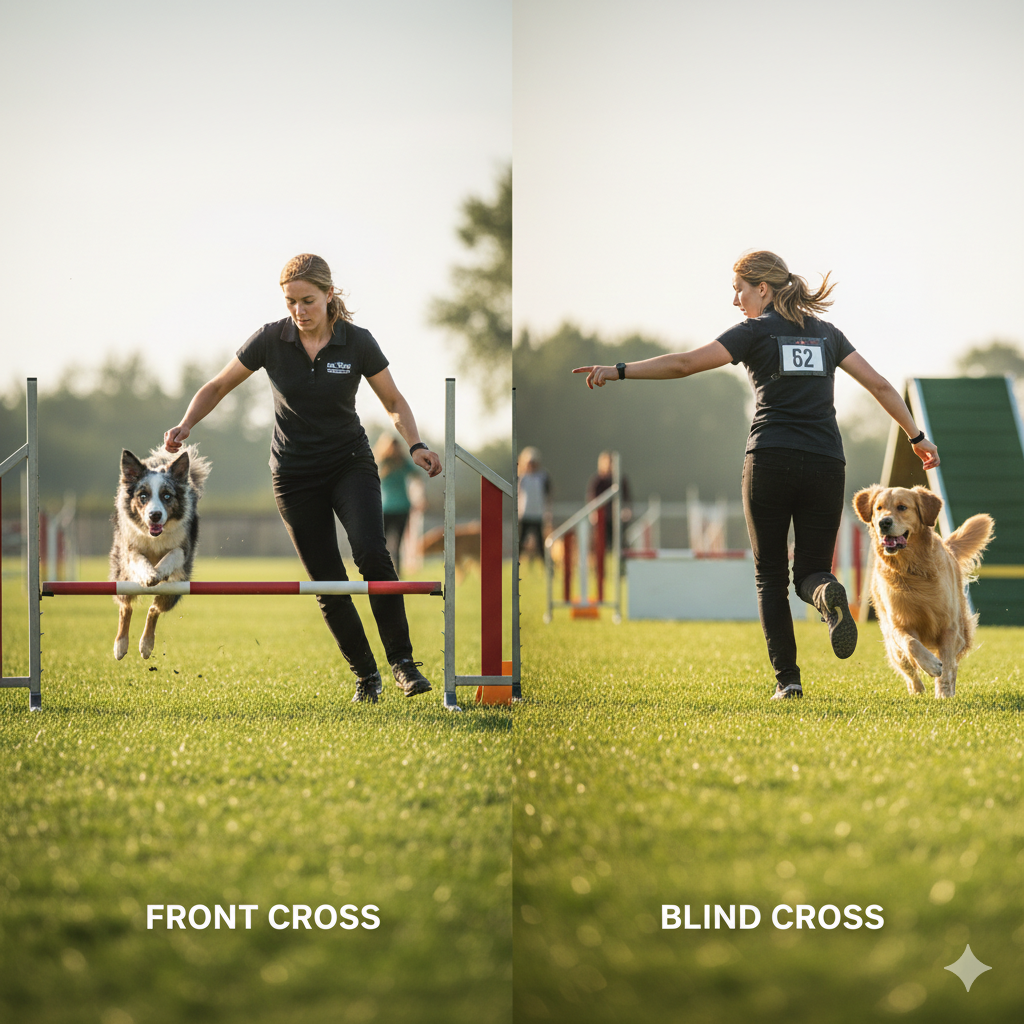
In dog agility, the dog’s job is to run the course. Your job, as the handler, is to tell them where to go and when to turn. This silent conversation is the heart of agility, and its grammar is made up of a series of handling maneuvers. Among the most fundamental, yet often misunderstood, are the Front Cross and the Blind Cross.
These aren’t just fancy moves for expert handlers; they are essential tools in your agility toolbox, allowing you to influence your dog’s path, maintain speed, and navigate complex sequences efficiently. Understanding when to use each, and how to execute them correctly, can shave seconds off your time and prevent costly faults.
Let’s decode these two vital handling lines.
The Basics: Understanding “Handling Lines”
Before diving into specific crosses, it’s crucial to grasp the concept of a “handling line.” This is the imaginary path you want your dog to take through the obstacles. Your goal as a handler is to stay ahead of your dog (or at least parallel) and use your body language, verbal cues, and movement to keep them on that ideal line.
Crosses are fundamental because they allow you to switch your dog from one side of your body to the other, often to set them up for the next obstacle or to keep yourself in a better position to lead.
The Front Cross: Precision and Path Control
The Front Cross is arguably the most common and versatile handling maneuver. It’s a method of switching your dog from one side of your body to the other by stepping in front of them.
How to Execute a Front Cross
- Dog on one side: Your dog is running on your left or right side (e.g., your left).
- Step in front: As your dog approaches you, you step across their path, effectively moving from one side of them to the other.
- Change lead hand: As you step across, you change your lead hand (the hand furthest from the dog, guiding them) and your chest orientation. Your new “outside” hand will now become the lead hand, pulling the dog’s attention to the new direction.
- Dog continues: Your dog continues on their path, now on your other side (e.g., your right), effectively turning around you.
When to Use a Front Cross
- Tight Turns: This is its primary use. A well-executed Front Cross creates a tight, efficient turn around an obstacle (often a jump), allowing your dog to gather themselves and quickly drive to the next obstacle.
- Example: Dog jumps #1, you Front Cross immediately after the landing, turning them sharply around you to jump #2.
- Setting Up for the Next Obstacle: When you need to put your dog on a specific side for an upcoming sequence (e.g., entering the weaves from a particular side, or setting up a contact obstacle).
- Maintaining Control: If your dog is getting too far ahead, a Front Cross can help you regain control and tighten their path.
- Dog’s Focus: A good Front Cross demands your dog’s attention on you, as you are physically moving into their space.
Benefits of the Front Cross
- Clarity: It’s a very clear cue for the dog as you physically block their original path and open up a new one.
- Tightness: Allows for the tightest turns, which are critical for speed on many courses.
- Control: Excellent for dogs who tend to overshoot obstacles or need a strong handler presence.
Potential Pitfalls
- Timing: If executed too early, your dog might turn before the obstacle. Too late, and you risk getting in their way, causing a collision or a wide turn.
- Speed: Requires the handler to be able to get across the dog’s path quickly. If the dog is much faster than you, it can be challenging.
The Blind Cross: Speed and Flow
The Blind Cross (sometimes called a “reverse cross” or “rear cross” in other contexts, though not strictly accurate terminology) is a maneuver where you turn your back to your dog for a split second as you switch sides. This allows your dog to continue on a relatively straight line or a flowing arc, maintaining maximum speed.
How to Execute a Blind Cross
- Dog on one side: Your dog is running on your left or right side (e.g., your left), heading towards an obstacle.
- Run ahead and turn: You run slightly ahead of your dog and then turn your body (often a 180-degree turn) in the direction of the next obstacle. As you turn, your back momentarily faces your dog.
- Dog switches sides: Your dog, seeing your turn and the new open path, continues past your body and ends up on your new side (e.g., your right).
- Lead hand change: Your lead hand changes as your body turns, opening up the path to the next obstacle.
When to Use a Blind Cross
- Maintaining Speed: This is its primary advantage. A Blind Cross minimizes deceleration for the dog, making it ideal for sequences where speed and flow are paramount.
- Example: Dog jumps #1, you perform a Blind Cross to quickly set them up for a straight line into a tunnel #2, maintaining momentum.
- Opening Up a Path: When you need to create a clear, unobstructed path for your dog to drive into an obstacle without slowing them down.
- Setting Up for Distance: If you need to send your dog to a distant obstacle while you fall behind slightly to handle another part of the course.
Benefits of the Blind Cross
- Speed: Allows the dog to maintain a higher speed and flow through a sequence.
- Less Interference: You are less likely to get in your dog’s way compared to a poorly timed Front Cross.
- Handler Efficiency: Can be more efficient for the handler in certain situations, allowing them to lead out or set up for the next sequence.
Potential Pitfalls
- “Blind” Moment: The brief moment your back is to your dog can be unsettling for some dogs, especially those lacking confidence or solid training.
- Loss of Connection: If your dog lacks strong verbal or body language understanding, they might get lost or switch off focus during the “blind” moment.
- Wider Turns: Often results in a slightly wider turn than a Front Cross, which can be costly on very tight courses.
Front Cross vs. Blind Cross: The Decision Tree
Deciding which cross to use is a strategic choice. Here’s a simplified decision tree:
- Do I need a tight turn?
- Yes: Front Cross
- No: Consider a Blind Cross or other options.
- Is speed and flow the absolute priority?
- Yes: Blind Cross (assuming your dog is well-trained for it).
- No: Consider a Front Cross for more control.
- Is my dog confident and able to work independently for a split second?
- Yes: Both are options.
- No: Stick to Front Crosses until confidence builds.
- Can I get there in time?
- If the answer is a clear “yes” and you need a tight turn: Front Cross.
- If your dog is much faster than you, a Blind Cross might be your only option to stay ahead or prevent getting in their way.
Training Tips for Mastering Crosses
- Start on the Flat: Don’t introduce crosses directly on equipment. Practice with a single cone, then two cones, then a single jump.
- Verbal Cues: Pair your physical movement with a consistent verbal cue (e.g., “Cross,” “Here,” or simply the name of the next obstacle).
- Build Drive: Ensure your dog has high toy or food drive and is eager to follow your movement.
- Slow Motion: Practice slowly at first, exaggerating your body language. Gradually increase speed.
- Repetition with Reward: Make sure every successful cross is followed by a big, clear reward.
- Handler Movement is Key: Your body position, shoulder orientation, and especially your feet are communicating to your dog. Practice keeping your feet moving and pointing where you want the dog to go.
Conclusion: The Art of the Conversation
Mastering Front Crosses and Blind Crosses is like learning the basic vocabulary of agility handling. They allow you to choreograph your dog’s dance on the course, creating elegant lines and maximizing efficiency. It’s a subtle art—a silent conversation carried on through movement, intention, and a deep understanding of your dog’s natural instincts.
Don’t be afraid to experiment, video yourself, and consult with experienced coaches. With practice and patience, you’ll soon be decoding courses and executing crosses with the finesse of a seasoned pro, guiding your dog to their fastest, most beautiful runs.

