


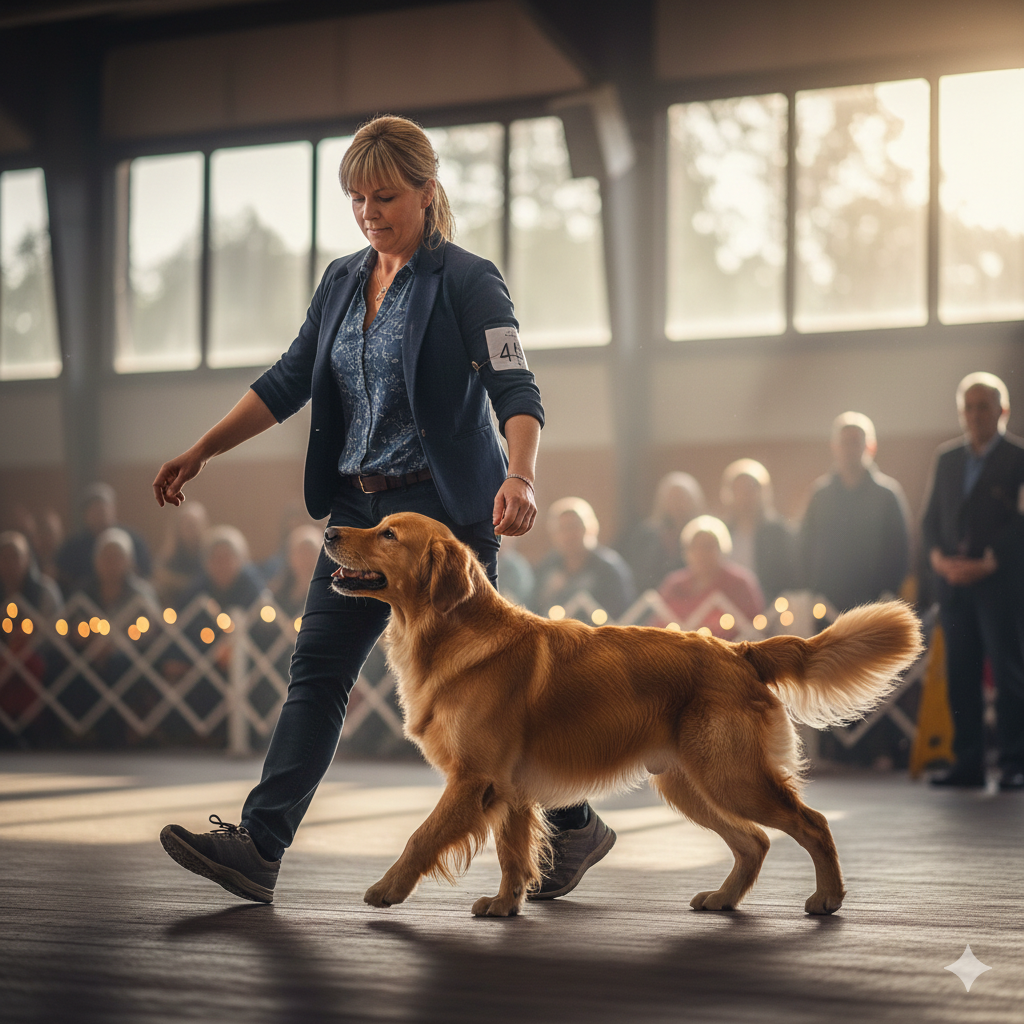
When most people hear the word “obedience,” they think of a puppy learning not to pee on the rug or a dog that finally sits when a treat is waved in front of its nose. But in the realm of canine athletics, Competitive Obedience is something entirely different. It is the “dressage” of the dog world—a sport of extreme precision, invisible communication, and a level of focus that borders on the telepathic.
Competitive Obedience isn’t just about a dog doing what it’s told; it’s about a dog doing what it’s told with joy, accuracy, and immediate responsiveness. It is a testament to the human-canine bond, refined into a high-stakes performance where a single crooked sit or a momentary glance away can be the difference between a qualifying score and a trip home.
What Exactly is Competitive Obedience?
At its core, Competitive Obedience is a series of standardized exercises designed to test a dog’s ability to follow commands and perform specific tasks in a trial environment. Unlike Agility, where the dog works at a distance at high speeds, Obedience is about controlled proximity.
The sport is governed by organizations like the American Kennel Club (AKC), the United Kennel Club (UKC), and international bodies like the FCI. While the specific rules vary by organization, the hierarchy of difficulty generally follows a path from “Novice” to “Utility.”
The Anatomy of an Obedience Trial
A trial takes place in a ring, usually marked by gating. A judge calls out the commands, and the handler must direct the dog without using food, toys, or excessive physical touching. The team starts with a perfect score (usually 200 points), and the judge deducts points for “faults”—anything from a slow response to a dog that bumps the handler’s leg during a turn.
The Three Pillars of Progress: Novice, Open, and Utility
To understand the scope of the sport, one must look at the three primary levels of competition. Each level introduces new complexities that challenge the dog’s mental endurance.
1. The Novice Level (Companion Dog – CD)
This is the entry point for most teams. It focuses on the “foundation” skills that every well-trained dog should have, but performed to a rigorous standard.
- Heel on Leash and Figure Eight: The dog must walk perfectly at the handler’s left side, keeping its shoulder level with the handler’s hip, while navigating through “posts” (people standing still).
- Stand for Examination: The handler moves away, and the judge approaches to pet the dog. The dog must stand perfectly still—no sniffing, no tail-wagging, no sitting—until the handler returns.
- Heel Free: The leash comes off. The dog must perform the same heeling pattern entirely off-leash.
- Recall: The dog is left in a stay, the handler moves across the ring, and the dog must come at a gallop and sit squarely in front of the handler.
2. The Open Level (Companion Dog Excellent – CDX)
In Open, the difficulty ramps up significantly. This level introduces jumping and “out-of-sight” work.
- Drop on Recall: The handler calls the dog, but midway through the gallop, the handler signals the dog to “down.” The dog must drop instantly, then wait for the command to finish the recall.
- Retrieve on Flat and Over High Jump: The dog must retrieve a wooden or plastic dumbbell, both on level ground and by clearing a hurdle.
- Broad Jump: The dog must leap over a series of low boards, covering a distance proportional to its height.
3. The Utility Level (Utility Dog – UD)
This is the “PhD” of dog training. It introduces complex concepts like scent discrimination and non-verbal communication.
- Scent Discrimination: The dog is presented with a pile of metal and leather articles. They must use their nose to find the one article that has the handler’s scent on it and bring it back.
- Directed Jumping: The handler sends the dog to the opposite end of the ring. On command, the dog must sit, then jump over whichever hurdle (high jump or bar jump) the judge indicates.
- Signal Exercise: The most beautiful part of the sport. The handler directs the dog through a series of commands (heel, stand, stay, drop, sit, and recall) using hand signals only. No talking is allowed.
The Precision Paradox: Accuracy vs. Spirit
The hallmark of a great Obedience team is the “Precision Paradox.” In the early days of the sport, dogs often looked like robots—mechanical and somewhat stoic. Modern judging, however, rewards “briskness and spirit.”
A dog that heels perfectly but looks miserable will score lower than a dog that is equally accurate but shows an upright head carriage, a wagging tail, and an “eager to please” expression. This shift has changed training methods from “compulsion-based” (using corrections) to “positive-reinforcement” (using games, clickers, and high-value rewards).
The “Heel” Factor: In high-level Obedience, heeling is an art. The dog’s eyes are often locked on the handler’s face. This is known as “focused heeling.” It requires immense core strength from the dog and unwavering concentration.
Why Does Obedience Matter? (The Benefits)
While it might look like “fancy tricks” to the casual observer, the benefits of Obedience training permeate every aspect of a dog’s life.
- Mental Longevity: As dogs age, they may not be able to run agility courses or chase flyballs. Obedience provides a low-impact way to keep their minds sharp well into their senior years.
- Safety: A dog that has a “Utility-level” recall or a “Drop on Recall” is a safe dog. If your dog is about to run into a busy street, an instant “down” command can save their life.
- The Invisible Bond: The level of communication required for the Utility Signal Exercise creates a “oneness” between handler and dog. You learn to read your dog’s slightest ear twitch, and they learn to read the tension in your shoulders.
- Public Manners: An Obedience-trained dog is a joy to take to outdoor cafes, hotels, and parks. They are calm, attentive, and reliable.
Is Your Dog an Obedience Candidate?
While any dog can learn basic manners, certain traits make for a stellar Competitive Obedience dog:
- Biddability: A fancy word for “the desire to work for the human.”
- Focus: The ability to ignore a barking dog in the next ring or a child dropping a hot dog in the stands.
- Physical Balance: The dog needs to be able to sit and stand squarely. Structural issues like hip dysplasia can make the repetitive sits of obedience uncomfortable, so physical health is paramount.
While Golden Retrievers, Border Collies, and Labradors are common sights in the obedience ring, the sport is open to all breeds. Seeing a “non-traditional” breed like a Bloodhound or a Bulldog achieve a Utility title is often the highlight of a trial, proving that any dog can achieve greatness with the right trainer.
How to Start Your Obedience Journey
- Find a Competition Club: Look for an AKC-affiliated training club. They offer “Star Puppy” and “CGC” (Canine Good Citizen) classes, which are the stepping stones to competitive work.
- Focus on the Foundation: Don’t worry about jumping or scent work yet. Spend months—even years—perfecting the “Sit” and the “Heel.” If the foundation is shaky, the advanced work will crumble.
- Watch a Trial: Go to a local show. Watch the Master handlers. Notice how they move, how they breathe, and how they reward their dogs.
- Keep it Fun: The biggest mistake beginners make is becoming too serious. If the dog isn’t having fun, you won’t get that “spirited” performance the judges are looking for.
Conclusion: The Silent Conversation
Competitive Obedience is the ultimate test of the human-canine partnership. It is a sport of silence, where the most profound things are said without a word. When you see a dog flying toward its handler on a recall, only to “skid” into a perfect sit-front, or a dog successfully sniffing out a metal dumbbell among a dozen others, you are seeing the result of hundreds of hours of mutual devotion.
It isn’t just about “doing what you’re told.” It’s about two different species learning to speak the same language with perfect clarity.

