


In the diverse ecosystem of canine athletics, we often see sports that fall into one of two camps: the “brain games” like Scent Work, which require deep concentration and slow, methodical movement, or the “speed games” like Flyball, which are all about adrenaline and explosive power. But what if you didn’t have to choose?
Welcome to the world of Scent Hurdling, a fast-paced, relay-style dog sport that demands the impossible: a dog that can sprint at full throttle while simultaneously maintaining enough mental composure to solve a complex olfactory puzzle. It is a sport of transitions—from the roar of the crowd and the heat of the race to the quiet, pinpoint accuracy of the nose.
What Exactly is Scent Hurdling?
Scent Hurdling is a team relay sport. Think of it as the refined, brainier cousin of Flyball. Two teams of four dogs each compete side-by-side in a race against the clock and each other.
The Course Layout
- The Run: A straight racing lane, typically 48 feet long.
- The Hurdles: Four hurdles (jumps) spaced evenly apart. The height of the hurdles is set based on the height of the smallest dog on the team (the “height dog”), ensuring a fair challenge for all sizes.
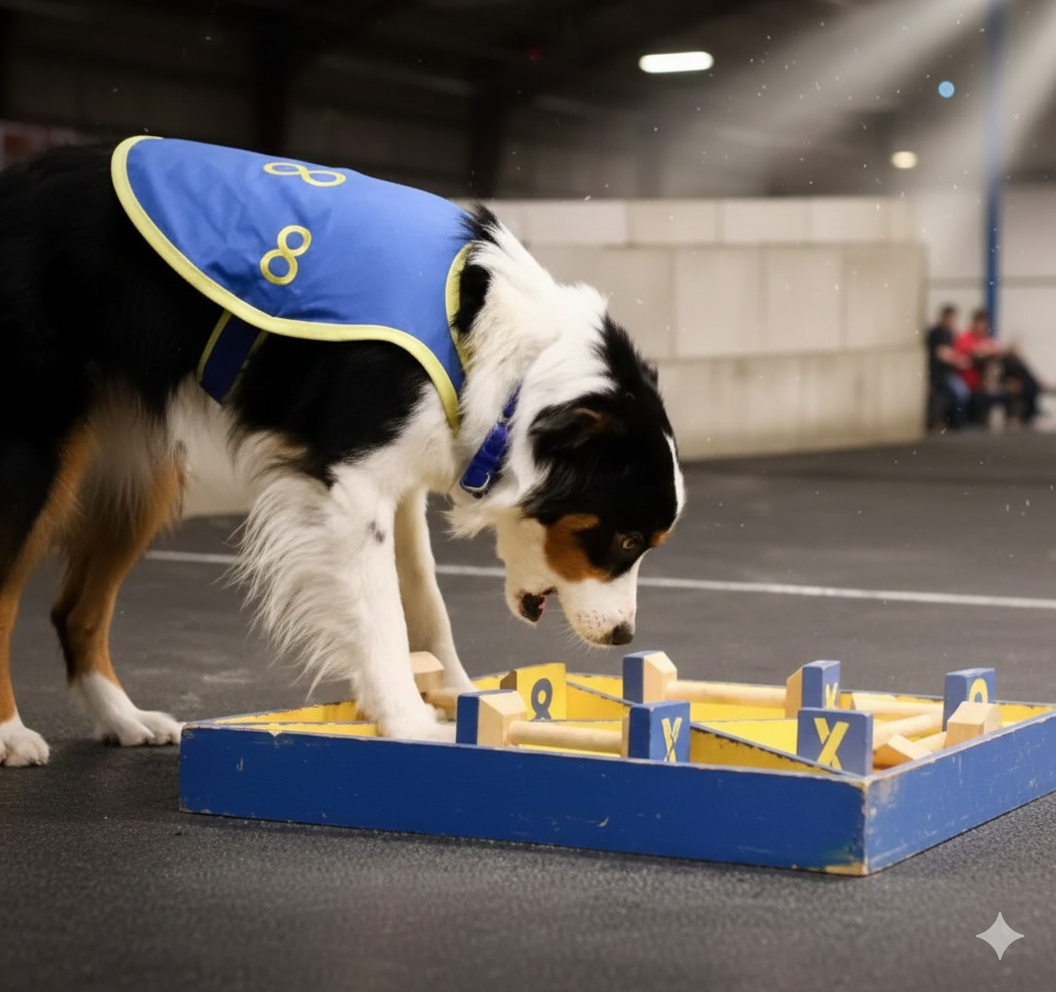
- The Scent Box: At the far end of the lane sits a specialized box or rack containing four dumbbells.
The Objective
Each dog on the four-dog team must:
- Sprint over the four hurdles.
- Locate their own personal wooden dumbbell (scented with their handler’s scent) from among the four identical-looking dumbbells in the box.
- Retrieve the correct dumbbell.
- Sprint back over the four hurdles and cross the start/finish line.
- Release the dumbbell to the handler so the next dog can be sent.
The team that finishes with all four dogs successfully retrieving their correct dumbbells in the fastest time wins the heat.
The Precision of the Nose: Scent vs. Sight
What makes Scent Hurdling uniquely difficult is the distraction factor. In Flyball, the dog simply has to hit a spring-loaded box to release a ball. In Scent Hurdling, the dog arrives at the box with their heart rate soaring and their respiratory rate at its peak.
Now, imagine trying to find a specific needle in a haystack while running a 100-meter dash. That is the challenge for the dog. They must immediately switch from “sprint mode” to “scent mode.”
The “Owner Scent”
The dumbbells are typically made of wood (which holds scent well). Before the race, handlers rub the dumbbell vigorously between their hands to imbue it with their unique scent. The other three dumbbells in the rack belong to the other handlers on the team. This means the dog isn’t just looking for a scent; they are discriminating between four very similar human scents—all of whom are people the dog likely knows and likes.
A Brief History: From Canada to the World
Scent Hurdling found its footing in the late 1960s and early 1970s, primarily in Canada. It was developed as a way to add a competitive, spectator-friendly edge to traditional obedience training. While obedience trials showed off a dog’s control, they lacked the “stadium energy” that sports like horse racing or track and field provided.
The Canadian Scent Hurdling Association (CSHA) was the pioneer in formalizing the rules, and the sport remains highly popular in Canada, as well as parts of the United Kingdom and Australia. While it hasn’t reached the massive commercial heights of Agility in the United States, it maintains a dedicated, cult-like following among trainers who appreciate the “dual-purpose” nature of the sport.
The Anatomy of a Winning Team
A Scent Hurdling team is a carefully balanced machine. Because the hurdle height is determined by the smallest dog, teams often look for a “Height Dog”—a small, fast terrier or Spaniel that allows the larger, faster Border Collies or retrievers to jump lower hurdles, saving them precious milliseconds.
The Roles
- The Start Dog: Usually the most stable dog. They need to set the pace without being disqualified for a “false start.”
- The Middle Dogs: Reliable “meat and potatoes” runners who can handle the pressure of dogs racing in the lane next to them.
- The Anchor: Often the fastest dog on the team. They carry the weight of the finish, needing to keep their head even when the race is neck-and-neck.
Why Scent Hurdling? The Benefits
Why choose this over a “pure” scent or speed sport? The benefits lie in the balance.
- Improved Emotional Regulation: This is the biggest takeaway for the dogs. Scent Hurdling teaches a dog how to “downregulate” their nervous system on command. Learning to go from high arousal (the sprint) to calm focus (the scent find) is a life skill that helps dogs remain calmer in real-world stressful situations.
- Total Body Fitness: The jumping and sprinting build explosive rear-end power and cardiovascular health, while the “searching” phase provides mental exhaustion.
- Team Synergy: Unlike individual sports, Scent Hurdling is about the team. If one dog fails, the whole team fails. This fosters a unique sense of community among handlers.
- Generalization of Skills: Because the sport involves jumping, retrieving, and scenting, it keeps a dog’s foundation skills sharp for other sports like Obedience or Agility.
Is Your Dog a Scent Hurdler?
Not every dog is cut out for the “dash and sniff.” The ideal candidate possesses:
- High Retrieval Drive: They must love to carry things. If a dog drops the dumbbell halfway back, the team is disqualified.
- Environmental Stability: The racing environment is loud. There are whistles, shouting handlers, and another dog sprinting just a few feet away. A dog that is easily spooked will struggle to focus on the scent box.
- Physical Soundness: Because of the repetitive jumping and sprinting, dogs must be in peak physical condition with healthy joints.
How to Get Started
If the idea of a high-speed scent relay appeals to you, here is your roadmap:
- Master the Retrieve: Your dog needs a “forced” or highly reliable retrieve. They must pick up the wooden dumbbell and bring it directly to your hand every single time.
- Introduce Scent Discrimination: Start at home. Use two identical wooden dumbbells. Scent one with your hands and leave the other “cold.” Reward your dog for touching or picking up the scented one. Gradually increase to four dumbbells.
- Build the Hurdles: Introduce jumps separately. Start low and focus on a straight, fast line.
- The Integration: This is the hardest part. Practice sending your dog over one jump to the scent rack, then two, then three.
- Join a Club: Scent Hurdling is nearly impossible to practice alone because you need a team! Look for local flyball or obedience clubs that might have a Scent Hurdling division.
Conclusion: The Thinking Athlete
Scent Hurdling is a beautiful paradox. It is a sport that celebrates the wild, raw speed of the dog while simultaneously honoring their sophisticated, ancient nose. It proves that a dog doesn’t have to be just an athlete or just a scholar—they can be both.
When you see a team in perfect sync—four dogs flowing over hurdles like water, snapping up their dumbbells with surgical precision, and crossing the finish line in a blur of fur—you are seeing the pinnacle of canine versatility. It’s not just a race; it’s a masterclass in focus under fire.

