


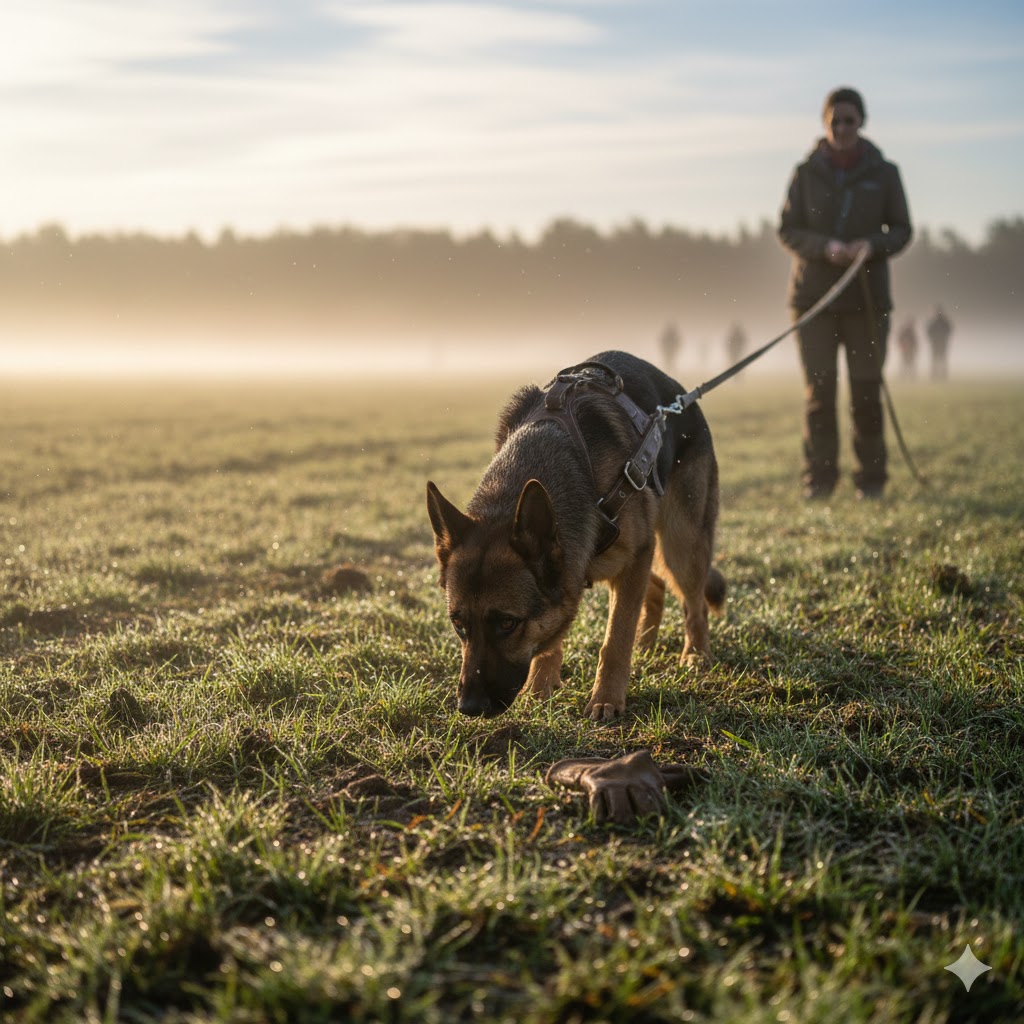
In a world filled with high-octane dog sports—dogs flying over hurdles, sprinting through tunnels, or leaping into pools—there exists a discipline that is remarkably quiet, intensely focused, and deeply profound. It is the sport of Tracking.
While other sports celebrate a dog’s physical speed or acrobatic prowess, Tracking celebrates their most ancient and powerful tool: the nose. It is a sport where the handler is literally “led by the nose,” surrendering control to the dog and trusting in a sensory world that humans can barely perceive. In Tracking, there are no cheering crowds or thumping music—just a dog, a long line, and the invisible, unraveling story of a human scent trail.
What is Competitive Tracking?
At its most basic level, Tracking is a canine sport that demonstrates a dog’s ability to recognize and follow human scent. Unlike Search and Rescue (where a dog might “air scent” to find a person in a general area), competitive Tracking is a “footstep” sport. The dog is required to follow the exact path taken by a person (the tracklayer), identifying every turn and finding “articles” (like a glove or a wallet) dropped along the way.
The Fundamentals of the Track
- The Scent: When a person walks, they shed thousands of microscopic skin cells (rafts), sweat, and chemicals. They also disturb the ground and vegetation, releasing distinct odors from crushed grass and soil. This cocktail of smells creates the “scent picture” the dog follows.
- The Start: The track begins at a “start stake.” The dog must determine the direction of the track and begin following it with intent.
- The Turns: As the levels increase, tracks become longer and include more turns (right angles, obtuse, or even acute angles).
- The Articles: These are small items made of leather, fabric, or metal. The dog must find them and signal their location to the handler, usually by lying down or sitting over them.
- The Length and Age: Tracks can range from 440 yards to over 1,000 yards, and they can be “aged” anywhere from 30 minutes to five hours before the dog is set on the trail.
A History of the Nose: From Survival to Sport
Tracking is perhaps the oldest “work” dogs have ever done for humans. From the earliest hunter-gatherers using wolves to track wounded game to the development of specialized bloodhounds in the Middle Ages, the ability to follow a trail has always been a matter of survival.
In the early 20th century, European police and military forces began formalizing tracking as a training discipline. However, it wasn’t until 1947 that the American Kennel Club (AKC) held its first official Tracking Test. The goal was to create a non-competitive environment where a dog could be judged against a standard of excellence rather than against other dogs.
To this day, Tracking remains one of the few dog sports where you don’t “compete” for first place. You either pass or you fail. It is a quest for a title, a personal challenge between you, your dog, and the environment.
The Levels of Achievement: Earning the Titles
Tracking titles are some of the most respected in the dog world because they cannot be “faked.” A dog either has the focus to follow the scent, or they don’t.
1. Tracking Dog (TD)
This is the entry-level title. The track is usually 440 to 500 yards long with three to five turns. It is aged for 30 minutes to two hours. The track is laid in an open field with consistent cover (like short grass). It is the foundation of the sport.
2. Tracking Dog Urban (TDU)
Introduced to accommodate handlers without access to large grassy fields, the TDU takes place in an “urban” environment—sidewalks, parking lots, and areas around buildings. This introduces the challenge of scent “puddling” on pavement and the interference of heavy human traffic.
3. Tracking Dog Excellent (TDX)
The “Master’s degree” of tracking. The track is longer (600-1000 yards), older (three to five hours), and far more complex. It includes “cross-tracks”—where two strangers walk across the original trail to distract the dog. It also features natural obstacles like fences, woods, or gullies.
4. Variable Surface Tracking (VST)
The ultimate challenge. A VST track must include at least three different surfaces, such as grass, gravel, and concrete. Scent behaves differently on hard surfaces than on vegetation, requiring the dog to adjust their sniffing technique mid-trail.
5. Champion Tracker (CT)
A rare and prestigious title awarded to dogs that have earned their TD (or TDU), TDX, and VST titles.
The Science of the Sniff: How It Works
To understand Tracking, you have to understand the dog’s nose. While humans have about 5 million olfactory receptors, a dog has up to 300 million. Their brains have an area dedicated to analyzing smells that is, proportionally, 40 times larger than ours.
When a dog tracks, they aren’t just smelling a person. They are smelling a chronology. Scent is heavier than air and tends to settle. In the grass, it gets trapped by moisture and blades. On a hot day, it might rise. In the wind, it might “drift” several feet off the actual path.
A skilled tracking dog learns to navigate these variables. They might “fringe” (walk slightly downwind of the track) or “overshoot” a turn and then circle back to find the strongest point of the scent. Watching a dog solve a “scent puzzle” at a corner is one of the most rewarding sights for a handler.
Why Tracking? The Benefits of the Long Line
Why would someone spend their Saturday morning at 5:00 AM in a damp, foggy field? The rewards are unique:
- Pure Partnership: Tracking is the only sport where the dog is 100% in charge. You are at the end of a 20-40 foot lead, and you have no idea where the track goes. You have to learn to “read” your dog—the set of their ears, the wag of their tail, the intensity of their pull.
- Mental Exhaustion: Sniffing is incredibly hard work. Fifteen minutes of intense tracking is often more tiring for a dog than an hour of running. It is the perfect outlet for high-energy or working breeds.
- Confidence Building: For shy or reactive dogs, Tracking is a “safe” sport. There are no other dogs in the ring, no loud noises, and no pressure. The success of finding an article builds immense self-assurance.
- Low Impact: Because it is performed at a walking or slow jogging pace, Tracking is accessible to senior dogs and handlers with physical limitations.
- Connection to Nature: It forces you to observe the world—the direction of the wind, the dampness of the soil, the way scent pools under a tree.
The Gear: What You Need
Tracking is one of the least expensive sports to start. You don’t need fancy agility equipment or a bite suit.
- The Harness: A non-restrictive harness that allows the dog to lean in and pull comfortably. The leash attachment is usually on the back.
- The Long Line: A 20 to 40-foot lead made of leather, nylon, or Biothane. This allows the dog to work independently while staying connected to you.
- Articles: Gloves, socks, or wallets.
- Flags: Small stakes to mark your start and (during training) your turns.
- High-Value Rewards: Tracking is hard work! Most handlers use “jackpot” treats (liver, cheese, or steak) hidden under the final article.
How to Get Started: The First Footsteps
If you want to try Tracking, forget everything you know about “Heel.” In this sport, we want the dog to pull!
- The Scent Box: Start by stomping down a small square of grass (disturbing the earth). Drop some treats in the square. Let the dog learn that “disturbed earth + my human = food.”
- The Straight Line: Walk a short, 20-foot straight line, dropping a treat in every footstep. At the end, place a “jackpot” (a pile of treats) on an article like an old glove.
- Trust the Nose: As the dog gets the idea, start spacing the treats further apart until they are only at the beginning and the end.
- Add Turns: Once the dog is “glued” to the straight line, add a gentle curve, then a 90-degree turn.
- Find a Mentor: Tracking has many nuances. Joining a local tracking club or finding a judge who gives seminars is the best way to learn how to handle the long line and read the wind.
Conclusion: The Ultimate Act of Faith
Tracking is a humbling sport. It reminds us that our dogs possess a superpower we can never truly share. When you stand at the start of a TDX track, looking out over a massive, empty field, and your dog puts their head down and starts to pull, it is an act of total faith.
You are following them into a world of invisible ribbons of scent, trusting their ancient instincts to lead you through the grass, over the fences, and through the woods to a hidden glove. It is quiet, it is slow, and it is beautiful. In the silence of the track, the bond between human and dog is whispered through the line, one sniff at a time.

