


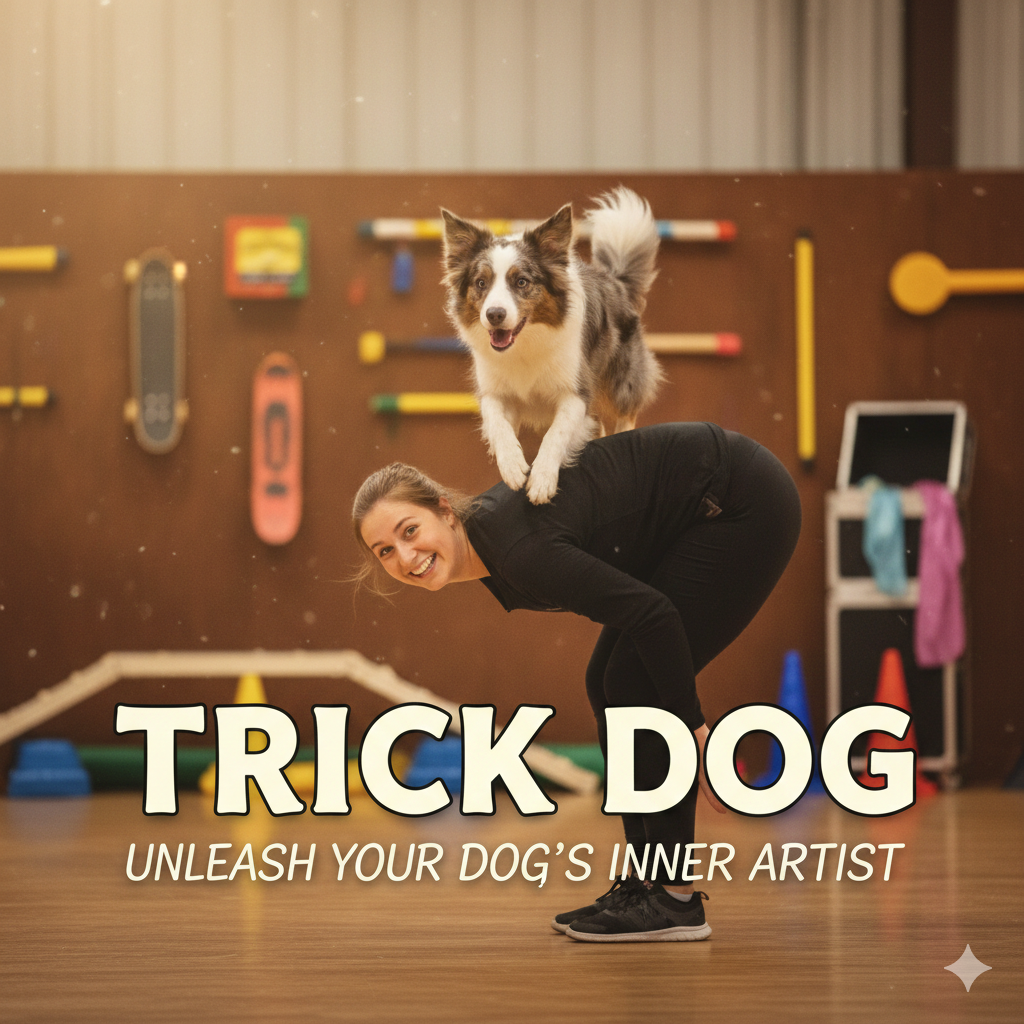
When people think of dog training, they often imagine the “serious” stuff: the sharp “heel” of competitive obedience, the intense focus of tracking, or the life-saving skills of a search and rescue dog. But there is a vibrant, rapidly growing sector of the canine world where the primary goal isn’t utility or survival—it’s pure, unadulterated creativity.
Welcome to the world of Trick Dog. Once relegated to the fringes of circus history or occasional party tricks, Trick Dog has blossomed into a formalized, titled sport recognized by major organizations like the American Kennel Club (AKC) and Do More With Your Dog! (DMWYD). It is a sport that celebrates the unique personality of every dog, the ingenuity of every handler, and the sheer joy of the human-canine bond.
What Exactly is Trick Dog?
At its heart, Trick Dog is a sport that involves teaching a dog to perform a series of “tricks” or behaviors that go beyond standard obedience. These can range from the simple (shaking paws) to the complex (riding a skateboard) to the theatrical (performing a scripted skit with props and music).
Unlike other sports that have rigid rules on exactly how a dog must move, Trick Dog is remarkably flexible. If your dog is a natural jumper, you can focus on athletic tricks. If they are a scent-work superstar, you can focus on “find it” tricks. It is the “freestyle” of the dog world, where the only limit is your imagination and your dog’s physical capabilities.
The Evolution of the Trick: From Side-Show to Sport
Dogs have been performing tricks for as long as humans have lived alongside them. From the dancing dogs of the Middle Ages to the legendary “Wonder Dogs” of the early 20th-century cinema, tricks have always been a way for dogs to earn their keep through entertainment.
However, the formalization of Trick Dog as a sport is a relatively recent phenomenon. In the early 2000s, Kyra Sundance, a world-renowned stunt dog performer and author, founded Do More With Your Dog! (DMWYD). Her goal was to create a structured path for handlers to earn titles and recognition for their training efforts.
The success of DMWYD caught the attention of the American Kennel Club (AKC), which launched its own Trick Dog program in 2017. This was a watershed moment for the sport, as it allowed mixed-breed dogs and “pet” dogs to earn official AKC titles, bringing thousands of new enthusiasts into the world of competitive training.
The Ladder of Learning: Understanding the Titles
Trick Dog is structured into progressive levels. To earn a title, a handler must demonstrate that their dog can perform a set number of tricks from a pre-approved list (or “propose” their own of equal difficulty).
1. Novice Trick Dog (TKN)
The entry point. The dog must perform 10 tricks. These are the “building blocks” of the sport:
- Balance Beam: Walking across a low, narrow surface.
- Crawl: Moving forward while keeping the belly on the ground.
- High Five: Touching the handler’s hand with a paw.
- Spin in Circles: A fundamental movement trick.
2. Intermediate Trick Dog (TKI)
The dog must perform 10 intermediate-level tricks. This level introduces props and more complex motor skills:
- Open a Door: Using a tug or nose-bump.
- Leg Weaves: Weaving between the handler’s legs as they walk.
- Scent Discrimination: Finding a hidden object.
- Wobble Board: Balancing on a moving surface.
3. Advanced Trick Dog (TKA)
This is where the training gets impressive. The dog must perform 10 advanced tricks, often requiring multi-step behaviors or “chains”:
- Back Up: Walking backward in a straight line for several feet.
- Hide Your Eyes: Putting a paw over the face.
- Jump into Handler’s Arms: A high-trust, athletic maneuver.
- Tissue Out of Box: A precision task.
4. Trick Dog Performer (TKP)
This level moves away from a simple checklist and into performance art. The handler must create a 3-5 minute routine that tells a story. The dog must perform at least two intermediate and two advanced tricks using props. It is judged on flow, creativity, and the “wow” factor.
5. Trick Dog Elite Performer (TKE)
The pinnacle of the sport. The routine must be 5-7 minutes long, involve a complex story, and feature at least five advanced or performer-level tricks. This is essentially a “stunt dog” show in a competitive format.
The Training Philosophy: It’s All About the “Yes”
What sets Trick Dog apart from “high-pressure” sports like Schutzhund or Field Trials is the Training Atmosphere. Trick Dog is almost exclusively taught using positive reinforcement (clickers, treats, toys, and praise).
Because the behaviors aren’t “mandatory” for life or safety, the stakes are low. If a dog fails to learn “roll over,” no one gets hurt. This allows handlers to be patient and playful.
- Shaping: Many tricks are taught by “shaping”—rewarding small, incremental movements that eventually lead to the full behavior.
- Luring: Using a treat to guide the dog’s nose into the desired position.
- Capturing: Waiting for the dog to do something natural (like sneezing or bowing) and immediately rewarding it so they repeat it.
Why Trick Dog? The Profound Benefits
While the end result might be a dog that can “play dead,” the real value of Trick Dog lies in the process.
1. Unmatched Mental Enrichment
Training a new trick is a puzzle for a dog. It requires them to focus, try new things, and solve the problem of “What does my human want me to do to get that treat?” This mental fatigue is often more effective at calming a high-energy dog than a long walk.
2. Building the “Insecure” Dog
Trick Dog is the ultimate confidence builder. For a shy or rescue dog, learning that they can control their environment and earn rewards through their own actions is transformative. Each “Good dog!” and each successful trick is a brick in the wall of their self-esteem.
3. Physical Proprioception
Proprioception is a dog’s awareness of where their body is in space. Tricks like backing up, walking on a balance beam, or “paws up” on a stool teach dogs to use their core muscles and back legs, which reduces the risk of injury in daily life.
4. The Universal Sport
Trick Dog is the most inclusive dog sport. A 15-year-old dog with arthritis can earn a Novice title by doing low-impact tricks like “speak” and “touch.” A dog in a wheelchair can do “find the scent” or “touch.” It doesn’t matter if your dog is 2 lbs or 150 lbs; there are tricks for everyone.
Getting Started: From the Living Room to the Ring
One of the best things about Trick Dog is that you don’t need a field, a tunnel, or expensive equipment. You can start today in your kitchen.
- Find a “High-Value” Motivator: Discover what your dog loves most—tiny pieces of cheese, a favorite squeaky toy, or even just enthusiastic belly rubs.
- Start Small: Choose three easy tricks. “Touch” (touching their nose to your palm), “Spin,” and “Shake” are great starters.
- Short Sessions: Dogs learn best in 5-minute bursts. Keep the energy high and the frustration low.
- Capture the Natural: Watch your dog. If they naturally “bow” when they wake up, say “Bow!” and give them a treat. You’ve just started training.
- Use Props: Once they get the basics, introduce household items. A laundry basket can be a “go to your place” prop; a broom can be a “jump over” prop.
- Find an Evaluator: When you’re ready for your title, look for an AKC or DMWYD evaluator. Many now accept video submissions, meaning you can earn your titles without ever leaving your home!
The Social Component: Trick Dog Communities
Because Trick Dog is so creative, it has fostered a wonderful online and in-person community. Owners often share videos of their “training fails” (which are usually hilarious) and celebrate each other’s “Aha!” moments. It is a sport devoid of the elitism that can sometimes creep into more traditional circles. It’s just people who really, really love their dogs.
Conclusion: More Than Just a Trick
In the end, Trick Dog isn’t about the title or the ribbon. It’s about the look in your dog’s eyes when they finally “get it.” It’s about the laughter in your living room when your dog decides that “back up” actually means “back up until I hit the couch and fall over.”
It is a celebration of the fact that our dogs are not just pets or workers—they are our partners in play. By teaching them tricks, we are learning to speak their language, and they are learning to trust our lead. So, grab some treats, find a quiet corner of your house, and start your Trick Dog journey today. Your dog—and your bond—will be better for it.

