


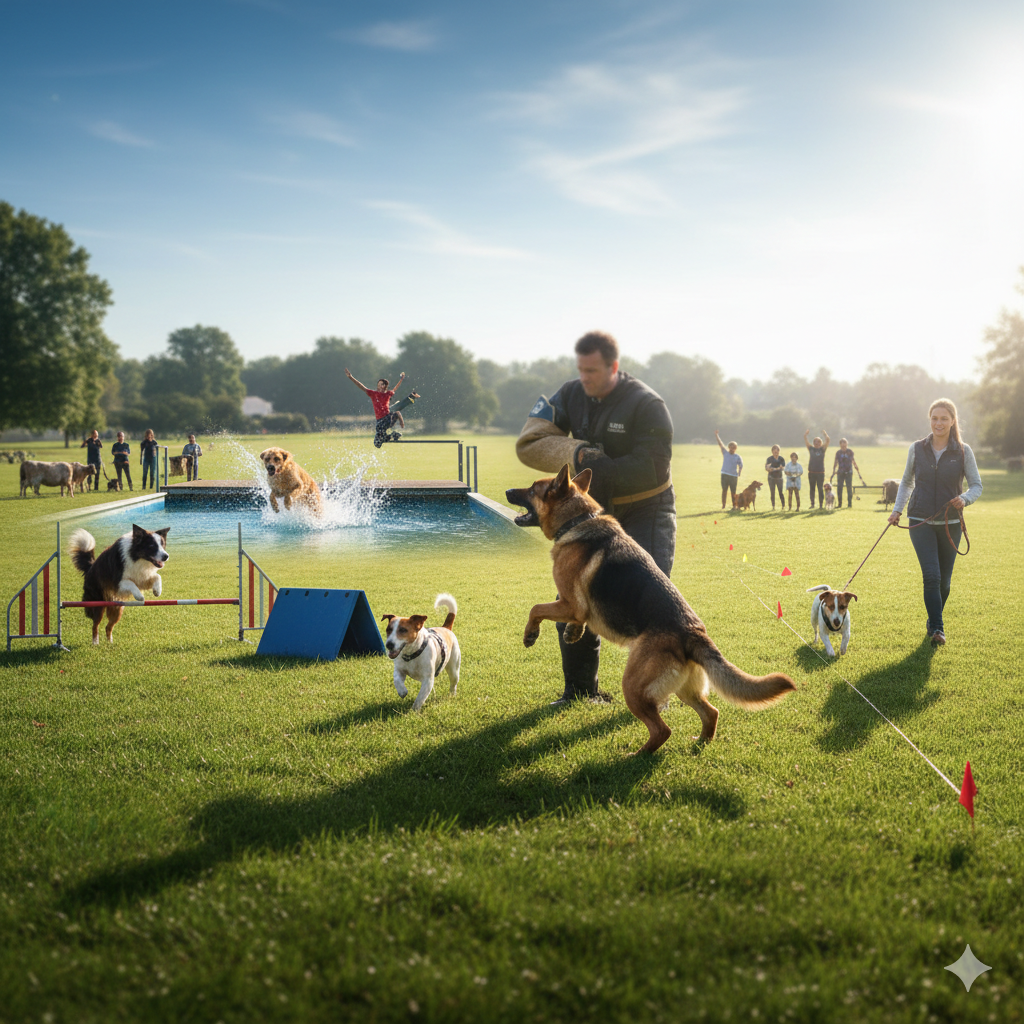
For most people, a “good dog” is one that sits on command and doesn’t chew the furniture. But there is a parallel universe where “good” isn’t enough—where dogs are athletes, thinkers, and partners in high-stakes competition. Welcome to the world of dog sports, a diverse and rapidly expanding landscape where the ancient bond between humans and canines is forged into something extraordinary.
Whether it’s the lightning-fast velocity of Flyball, the quiet focus of Tracking, or the intense physical demands of Agility, dog sports offer a path to fulfillment for every breed and every temperament. In this guide, we’ll explore the major disciplines, the benefits of getting involved, and why this global phenomenon is much more than just a hobby—it’s a lifestyle.
1. The Adrenaline Junkies: Speed and Agility
The most recognizable dog sports are those that emphasize raw athleticism and speed. These are the “spectator sports” of the dog world, often featured on television and drawing massive crowds.
Agility
Agility is arguably the most popular dog sport worldwide. It is a race against the clock where a handler directs a dog through a complex obstacle course. The dog must navigate tunnels, weave poles, see-saws, and various jumps in a specific order, all while off-leash and without the handler touching them.
- The Challenge: It requires a perfect blend of physical speed and mental “biddability.” The handler must use body language and verbal cues to guide the dog, often while running at full tilt themselves.
- Best Breeds: While any breed can play, Border Collies, Shelties, and Papillons often dominate the podium due to their high power-to-weight ratio.
Flyball
If Agility is a solo gymnastic routine, Flyball is a drag race. It is a relay race involving two teams of four dogs. Each dog must sprint over four hurdles, trigger a spring-loaded box to release a tennis ball, catch the ball, and race back over the hurdles so the next dog can be released.
- The Thrill: It is loud, chaotic, and incredibly fast. High-level Flyball teams complete the entire four-dog relay in under 15 seconds.
2. The Intellectuals: Scent and Memory
Not all athletes wear cleats; some wear thinking caps. These sports prioritize the dog’s incredible olfactory system—a sense that is roughly 10,000 to 100,000 times more acute than our own.
Scent Work (Nose Work)
Mimicking the training of bomb or drug detection dogs, Scent Work asks pet dogs to find specific essential oils (like Birch or Clove) hidden in containers, rooms, or vehicles.
- The Benefit: This is one of the most inclusive sports. Senior dogs, dogs with physical disabilities, and even “reactive” dogs can compete because they work one-at-a-time in a controlled environment.
Tracking
Tracking is the “marathon” of the scent world. A dog is given a scent at a start stake and must follow a human’s trail across natural terrain, sometimes hours after the person has left.
The dog must find “articles” (like a glove or wallet) dropped along the way. Unlike Scent Work, which is often done indoors or in small areas, Tracking takes place in the great outdoors, requiring the dog to ignore the scents of rabbits, deer, and other environmental distractions.
3. The Working Heritage: Herding and Protection
Many dog sports were created to preserve the functional abilities of specific breeds. These sports keep the “work” in “working dog.”
Herding Trials
For breeds like Kelpies, Corgis, and Border Collies, herding is in the blood. In a trial, a dog must move a group of sheep or ducks through a series of gates and into a pen, guided only by the handler’s whistles and commands.
- The Complexity: It requires the dog to have “eye” (the ability to stare down livestock) and the judgment to know when to pressure the animals and when to give them space.
IGP (Schutzhund)
Originally a breed suitability test for German Shepherds, IGP consists of three phases: Tracking, Obedience, and Protection. The protection phase involves the dog apprehending a “helper” wearing a padded sleeve.
- The Misconception: While it looks aggressive, it is actually a test of extreme control and temperament. A dog must release the bite instantly on command and remain perfectly steady under pressure.
4. The Modern Innovators: Disc Dog and Dock Diving
In the last few decades, several “freestyle” sports have emerged that lean into the sheer fun of being a dog.
Disc Dog (Frisbee)
This involves more than just a game of catch in the park. Competitive Disc Dog includes “Distance/Accuracy” events and “Freestyle” routines where dogs perform flips, vaults off the handler’s back, and acrobatic catches set to music.
Dock Diving
Simple and exhilarating: a dog runs down a 40-foot dock and leaps into a swimming pool to grab a toy.
Events are judged on “Big Air” (distance) or “Extreme Vertical” (height). It is a favorite for water-loving breeds like Labradors and Golden Retrievers.
Why Get Involved? The Hidden Benefits
Beyond the ribbons and titles, dog sports provide three core benefits that improve the lives of both ends of the leash:
- Mental Enrichment: Most “behavioral issues” in pet dogs stem from boredom. A dog with a job—whether that’s finding a hidden Q-tip or navigating a tunnel—is a dog that isn’t chewing your baseboards.
- Physical Health: With canine obesity on the rise, sports offer a structured way to keep your dog lean and muscular. It also keeps handlers active!
- The “Invisible String”: The level of communication required for these sports creates a deep, intuitive bond. You learn to read your dog’s slightest ear flick, and they learn to anticipate your next move.
How to Choose the Right Sport for Your Dog
Not every dog is a fit for every sport. Choosing the right one requires an honest assessment of your dog’s “drive” and physical build.
| Dog Trait | Recommended Sport |
| High Energy / Loves to Run | Agility, Flyball, Disc Dog |
| Obsessed with Sniffing | Scent Work, Tracking |
| Loves Water | Dock Diving |
| Calm / Enjoys Precision | Competitive Obedience, Rally |
| Strong “Prey Drive” (Loves to Chase) | Lure Coursing, Fast CAT |
Getting Started: Your First Steps
The world of dog sports can feel intimidating, but it is remarkably welcoming to newcomers.
- Find a Local Club: Most sports are governed by organizations like the AKC, UKC, or specialized groups like the North American Flyball Association (NAFA). Look for clubs in your area that offer “Intro to…” classes.
- Start with Basic Obedience: A solid “Sit,” “Stay,” and “Recall” are the prerequisites for almost every sport.
- Focus on Fun: In the beginning, the goal should be building your dog’s confidence. If the dog is having a blast, the skills will follow.
Conclusion: The Ultimate Partnership
Dog sports are a testament to the versatility of the canine species. They prove that dogs are capable of incredible feats of memory, athleticism, and emotional intelligence. But more than that, they are a celebration of the human-canine partnership.
When you see a dog and handler move as one on an Agility course, or a Tracking dog find a tiny leather scrap in a ten-acre field, you aren’t just seeing a trained animal—you’re seeing a conversation. You’re seeing two different species speaking a silent language of trust and shared purpose.

