


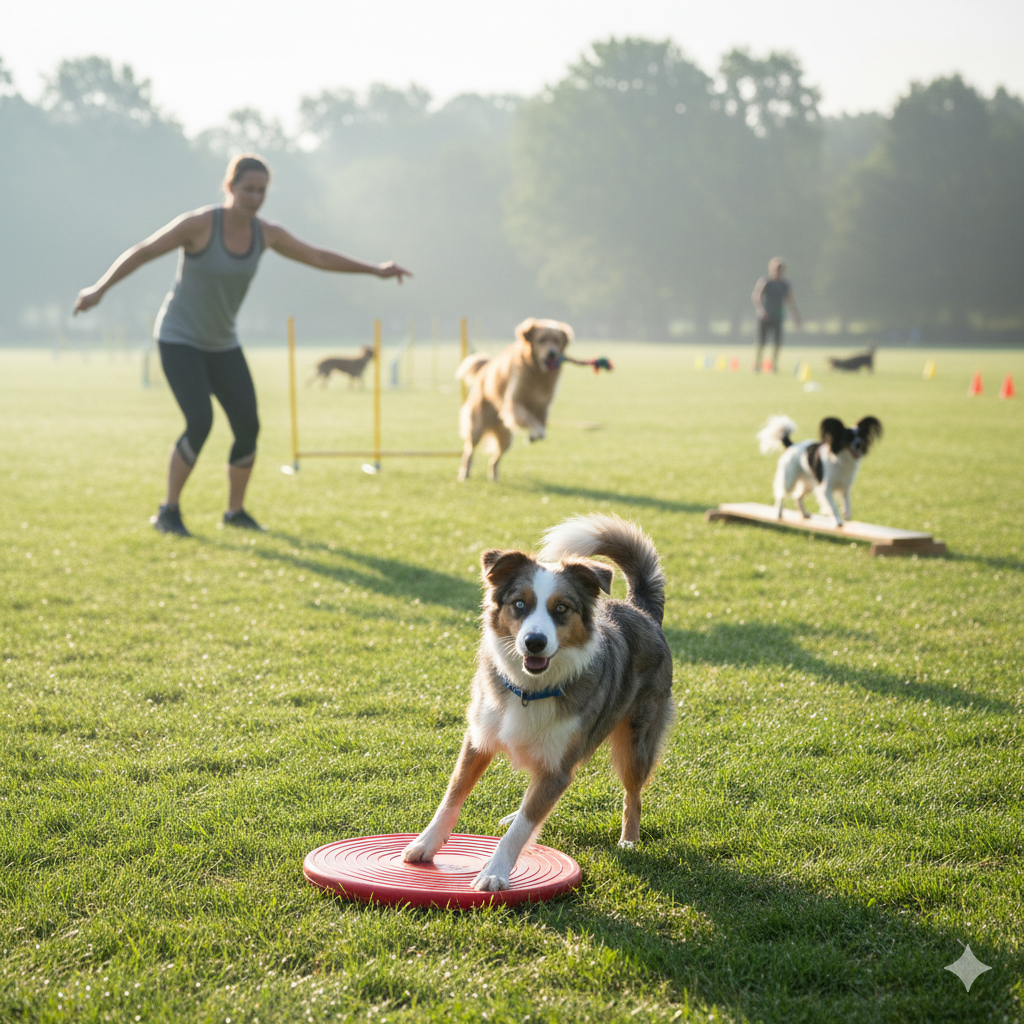
It is the siren song of the dog park and the training center: the brightly colored tunnels, the towering A-frame, and the rhythmic clicking of the weave poles. For most new handlers entering the world of dog agility, the goal is to get the dog on the equipment as fast as possible. We want to see the “fly,” the “climb,” and the “sprint.”
However, if you ask any world-class agility competitor what the most important part of their training is, they won’t point to the see-saw or the jumps. They will point to a patch of flat grass.
Welcome to the world of Agility Foundations. This is the invisible work—the “flatwork”—that happens long before a dog ever sees a piece of PVC pipe or a rubber-coated ramp. Training foundations is like building the chassis of a high-performance race car; without a solid frame and a responsive steering system, the most powerful engine in the world will simply crash at the first turn.
In this guide, we’re going to break down the essential skills you should master before your dog’s paws ever touch a piece of equipment.
1. The Power of Focus: The “Check-In”
In a sport where dogs run off-leash at high speeds amidst screaming crowds and barking competitors, focus is your most valuable currency. If your dog isn’t looking at you, they can’t see your cues.
The Goal
Your dog should choose to look at you even when the world is fascinating. We call this “Engagement.”
How to Train It
Start in a quiet environment. Every time your dog looks at you without being prompted, reward them. Gradually move to more distracting environments (the front yard, a park, the parking lot of a pet store). You are teaching the dog that you are the source of all things wonderful, and “checking in” is the most rewarding behavior they can offer.
2. Rear-End Awareness: The Secret to Safety and Speed
Dogs are “front-wheel drive” animals. They generally know where their front paws are, but they often treat their back legs like a trailer—just along for the ride. In agility, a dog needs to be “four-wheel drive.” They must know how to use their hindquarters to pivot, drive off jumps, and balance on narrow surfaces.
The Goal
The dog should be able to move their back legs independently of their front legs.
How to Train It
- The Pivot: Place a small, non-slip “perch” (like a rubber feed tub or a thick book) on the ground. Teach your dog to put their front paws on the perch and stay there while they “pivot” their back legs in a circle around the perch.
- Backing Up: Teach your dog to walk backward in a straight line. This forces them to engage their glutes and hamstrings.
- Cavalettis: Lay a series of poles on the ground (no height) and have your dog walk over them. This encourages them to lift each leg individually and judge distances.
3. Recall and “The Chase”: Building Drive
Agility is, at its core, a game of “Follow the Leader.” If your dog doesn’t want to chase you, you will spend your time on the course begging them to keep up.
The Goal
A “Velcro” recall. Your dog should see you running away and think, “I have to get to that person as fast as humanly possible!”
How to Train It
Play “Restrained Recalls.” Have a friend hold your dog while you run away, acting excited and waving a toy. When your friend lets go, the dog should launch toward you. This builds the “sprint” mindset required for the start line.
4. Directional Cues: The Steering Wheel
On an agility course, you will often be several feet (or yards) away from your dog. You need a way to tell them which way to turn before they get to the jump.
The Goal
Teaching “Left” and “Right” (or “Gee” and “Haw”) on the flat.
How to Train It
Using a simple cone or a bucket, teach your dog to “wrap” the object.
- “Wrap” or “Tight”: The dog circles the cone tightly and returns to you.
- “Left/Right”: As you walk with your dog, give the cue and turn. Reward the dog for staying in the “pocket” of your leg as you change direction.
5. Position and “The Wait”: The Start Line Stay
The most stressful part of an agility run is often the first three seconds. You need to be able to lead out—walk away from your dog toward the first jump—while they stay perfectly still, coiled like a spring, waiting for the release.
The Goal
A rock-solid “Stay” under high arousal.
How to Train It
This isn’t your standard “Stay” while you’re in the kitchen. This is a stay while you are running, jumping, and shouting “Woo-hoo!” Start by asking for a sit. Take one step away. Reward. Gradually increase the distance and the “distraction” (jumping jacks, running in place). If the dog breaks, simply reset. The “Release” (usually a word like “GO!” or “OK!”) should be the most exciting part.
6. Value for “The Side”: Handling Positions
In agility, you will handle your dog from both your left and right sides. Most dogs have a “preferred” side where they feel more comfortable. You need to equalize that.
The Goal
The dog is equally comfortable and responsive whether they are on your left or your right.
How to Train It
Practice “Side Switches” or “Front Crosses” on the flat.
- Walk in a straight line with the dog on your left.
- Step across their path (a Front Cross) and move them to your right.
- Reward them for maintaining their pace and focus during the transition.
7. Toy Drive and Tugging: The Reward System
While many dogs are food-motivated, a toy is often the superior reward in agility. Why? Because you can play with the dog while moving. Tugging builds high arousal and allows for a “celebration” that keeps the dog’s energy up for the next sequence.
The Goal
A dog that will grab a toy and tug with enthusiasm on command.
How to Train It
Find a long, soft tug toy. Make it move like prey—darting across the ground, away from the dog. When they grab it, give a little resistance. Let them “win” the toy frequently. This builds the “desire to work” that translates to speed on the course.
8. Body Language: Learning to “Read” the Handler
Dogs are masters of human body language. In agility, your shoulders, your feet, and even your “inside hand” (the hand closest to the dog) act as a steering wheel.
The Goal
The dog understands that where your chest is pointing is where they should go.
How to Train It
Practice “Follow My Motion” drills. Move in different directions—backward, sideways, spinning—and reward the dog for staying with your movement. If you stop abruptly, the dog should stop. If you accelerate, the dog should accelerate.
9. Crate Games: Developing “Off-Switch” and Patience
Agility trials involve a lot of waiting. Your dog will spend time in a crate or on a mat while other dogs run. If they spend that time barking or stressing, they will have no energy left for their own run.
The Goal
The dog loves their crate and can relax in a high-intensity environment.
How to Train It
“Crate Games” (pioneered by Susan Garrett) are essential. Teach the dog that the crate is a “high-value” place where they get the best treats. They should learn to wait inside the crate even with the door open until they are given their release word.
10. Proprioception: The “A-Frame” of the Mind
Before a dog climbs a 5-foot-6-inch A-frame, they should understand the concept of “inclines” and “descents.”
The Goal
Confidence on varied surfaces and textures.
How to Train It
Walk your dog over bubble wrap, through shallow water, over crunchy leaves, and up/down small child-sized slides. This desensitizes them to the strange sensations they will encounter on the “contact” equipment (the A-frame, dog walk, and see-saw).
Summary: The Foundation Checklist
Before you sign up for that “Agility 101” class, ask yourself if your dog can do the following:
| Skill | Description | Why It Matters |
| Engagement | Looks at you in a busy park. | No focus = No handling. |
| The Pivot | Can move rear legs in a circle. | Crucial for tight turns. |
| Start Line Stay | Stays while you run 10 feet away. | Safety and a fast start. |
| Recall to Side | Comes to your left or right hip. | Base of all handling. |
| Toy Drive | Tugs with intensity. | Keeps the “work” fun. |
Conclusion: Slow Down to Go Fast
It is tempting to rush. We see the videos of dogs “flying” over jumps and we want that now. But agility is a physical and mental sport that places immense strain on a dog’s body and mind.
By spending 3-6 months focusing purely on foundations, you are doing two things:
- Preventing Injury: A dog with rear-end awareness is less likely to wipe out on a turn.
- Accelerating Future Learning: When you finally do introduce the jumps, your dog already knows how to follow your side, how to wait for a release, and how to focus on you. The equipment just becomes a new “prop” in a game they already know how to play.
Foundations aren’t the “boring” part of agility. They are the most important part. Build your chassis first—the speed will follow.

