


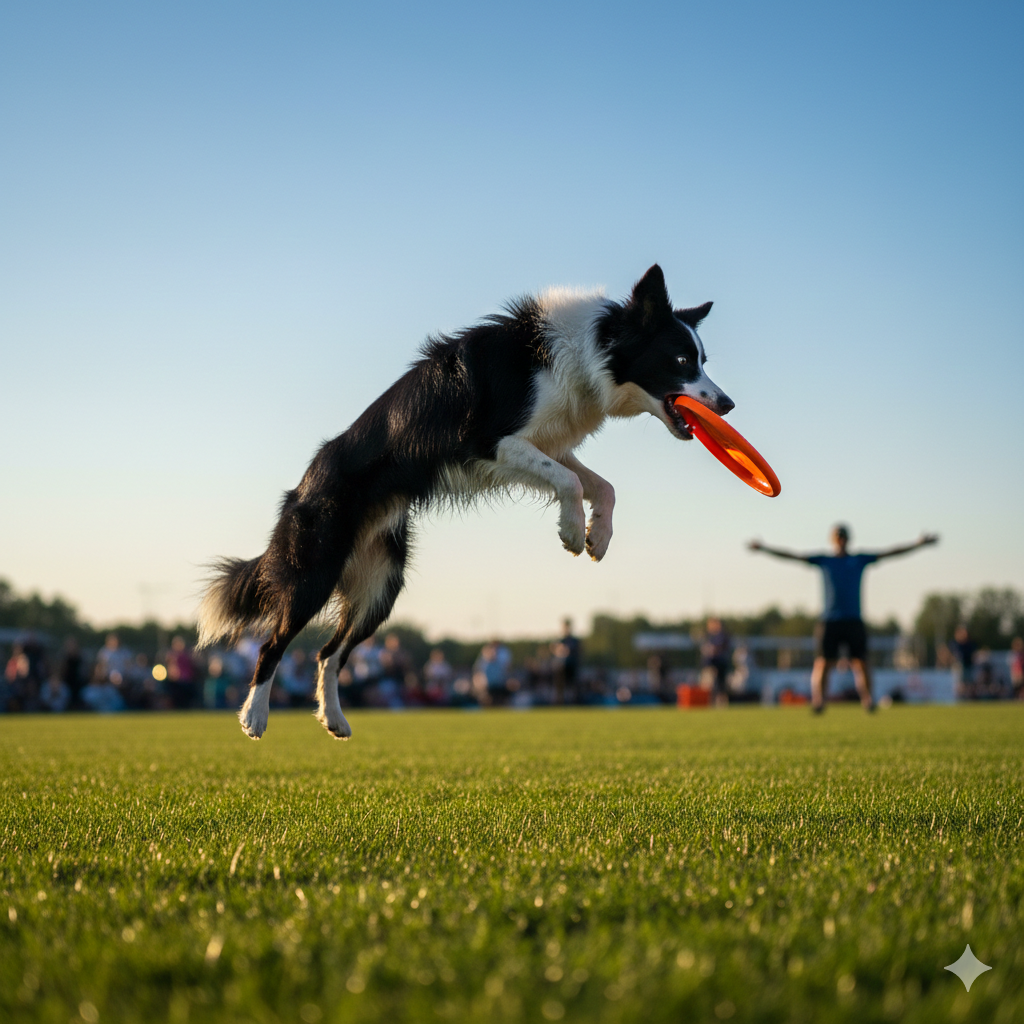
If you’ve ever spent a sunny afternoon at the park, you’ve likely seen a dog chasing a Frisbee. It’s a classic image of Americana—the flying disc, the leaping dog, the triumphant catch. But in the world of competitive Disc Dog (often called Frisbee Dog), that backyard game is elevated to an art form. It is a sport of gravity-defying acrobatics, pinpoint accuracy, and a level of synchronicity between human and canine that few other activities can match.
Unlike many dog sports that require specialized, heavy equipment like A-frames or spring-loaded boxes, Disc Dog is beautifully accessible. At its simplest, it’s just you, your dog, and a piece of plastic. At its peak, it’s a choreographed performance that looks more like a Cirque du Soleil routine than a game of fetch.
What is Disc Dog? The Three Pillars of Competition
While anyone can toss a disc in their backyard, competitive Disc Dog is generally divided into three main categories. Each tests a different set of skills for both the handler and the dog.
1. Distance/Accuracy (Toss & Fetch)
This is the most common entry point for beginners. In this event, the handler stands in a designated area and has a set amount of time (usually 60 seconds) to make as many throws as possible. The field is marked with different “zones.”
- Points are awarded based on how far the disc is thrown and whether the dog catches it cleanly.
- Bonus Points: Most organizations award extra points if the dog catches the disc with all four paws off the ground (a “mid-air” catch).
- This event tests the handler’s ability to throw consistently under pressure and the dog’s speed and tracking ability.
2. Freestyle
Freestyle is the “X-Games” of the dog world. This is a timed routine set to music, where the handler and dog perform a series of choreographed tricks and throws. In Freestyle, you’ll see:
- Passing: The dog weaves through the handler’s legs while catching discs.
- Multiple Discs: The handler may have 7 to 10 discs in the air in rapid succession.
- Vaults: The dog uses the handler’s body (back, chest, or legs) as a launching pad to jump higher and catch a disc mid-air.
- Over-the-Shoulder Catches: Complex throws where the dog must track the disc from behind the handler.Judges score Freestyle based on athletic ability, degree of difficulty, showmanship, and the variety of throws.
3. Long Distance
Exactly what it sounds like! This is a pure test of the handler’s arm and the dog’s speed. The goal is to achieve the longest possible catch. Some elite teams can successfully complete catches at distances exceeding 80 or even 90 yards.
The Gear: Not All Discs are Created Equal
One of the most common mistakes beginners make is using a standard, “human” Frisbee from a toy store. These are often made of hard, brittle plastic. When a dog bites down on them at high speed, the plastic can shatter or create sharp “teeth burrs” that can slice a dog’s mouth or gums.
Competitive discs are designed with “canine dental safety” in mind:
- Standard Discs: Lightweight and flexible, these are great for all-around play and don’t hurt the dog’s mouth.
- Bite-Resistant Discs: Made for dogs with a “hard mouth” (think Pit Bulls or German Shepherds) who might puncture a standard disc in one go. These are heavier and more durable.
- Cold Weather Discs: Standard plastic can become brittle in the winter. These are made of special polymers that stay soft in freezing temperatures.
The Making of a Disc Dog: Training and Technique
Success in Disc Dog isn’t just about having a dog that likes to chase things. It requires a specific set of foundational skills.
The “Take” and the “Drop”
Before you ever throw a disc, your dog needs to learn to take the disc gently from your hand and, more importantly, drop it on command. If your dog catches a disc but then spends two minutes playing “keep away,” you won’t get very far in a timed competition.
Tracking the Flight
Dogs naturally want to chase things that move away from them. However, catching a flying disc requires the dog to track the flight path and predict where the disc will land. Beginners often start with “rollers”—rolling the disc on its edge along the ground. This teaches the dog to follow the line of the disc and grab it while it’s moving.
The Handler’s Craft
In Disc Dog, the human has a massive responsibility. A bad throw can lead to a dog landing awkwardly and injuring itself. Handlers must master various grips and throws:
- The Backhand: The standard throw most people know.
- The Sidearm (Forehand): A flick of the wrist that allows for different angles.
- The Overhand Thumb Flip: Often used in Freestyle for quick, vertical pops.
- The Butterfly: A spinning, hovering throw that stays in one place for the dog to grab.
Safety First: Protecting Your Canine Athlete
Because Disc Dog involves high jumping and sudden changes in direction, safety is paramount.
- The Surface: Never practice on concrete or asphalt. Competitive Disc Dog should only be done on high-quality grass or specialized “agility flooring” that provides shock absorption.
- The “Landing”: In Freestyle, handlers are taught to throw the disc in a way that encourages the dog to land on its front feet first or all four feet simultaneously. “C-shaped” landings (where the dog twists mid-air and lands on its back legs) are dangerous and can lead to spinal or ACL injuries.
- Age Appropriateness: Puppies should never do high jumps or vaults. Their growth plates haven’t closed, and high-impact landings can cause permanent damage. Stick to ground-level “rollers” and short tosses until the dog is at least 14 to 18 months old.
Why Disc Dog is the Ultimate Bonding Sport
What makes Disc Dog special is the interdependence. In Agility, the obstacles are stationary. In Flyball, the box is always in the same place. In Disc Dog, the “target” is a moving object launched by the human.
If the handler throws too hard, the dog can’t catch it. If the dog isn’t paying attention, the throw is wasted. When you see a team in the “flow state,” it’s as if they are sharing a single brain. The dog watches the handler’s subtle shoulder movements to know where to run, and the handler adjusts their throw based on the dog’s speed and wind conditions.
How to Get Started
Does your dog have “toy drive”? Do they look at a tennis ball like it’s the most important thing in the world? If so, you’re halfway there.
- Buy Canine-Safe Discs: Pick up a 5-pack of competition-grade discs (brands like Hero Disc or Hyperflite are industry standards).
- Start Low and Slow: Start with “tugs” and “takes.” Make the disc the most exciting toy in the world.
- Find a Local Club: Look for “Skyhoundz,” “UFO (United Frisbee Association),” or “UpDog Challenge” events in your area. These organizations have standardized rules and offer a great way to meet experienced mentors.
- The UpDog Challenge: This is a particularly popular organization for beginners because they offer “games” that combine elements of agility and strategy with disc throwing, making it fun for dogs of all skill levels.
Conclusion: Gravity is Just a Suggestion
Disc Dog is a celebration of the joy of play. It’s a sport that rewards athleticism, creativity, and—above all—the relationship you have with your dog. There is no feeling quite like watching your best friend launch themselves into the air, silhouetted against a blue sky, and hearing the “clack” of the plastic as they make a perfect catch.
Whether you’re aiming for a world championship in Freestyle or just want to be the coolest team at the local park, Disc Dog offers a lifetime of challenge and fun. So grab a disc, find a patch of grass, and see just how high your dog can fly.

